
As nonprofits grow, informal HR practices can create new challenges. Learn when to strengthen policies, management systems, and compliance practices.
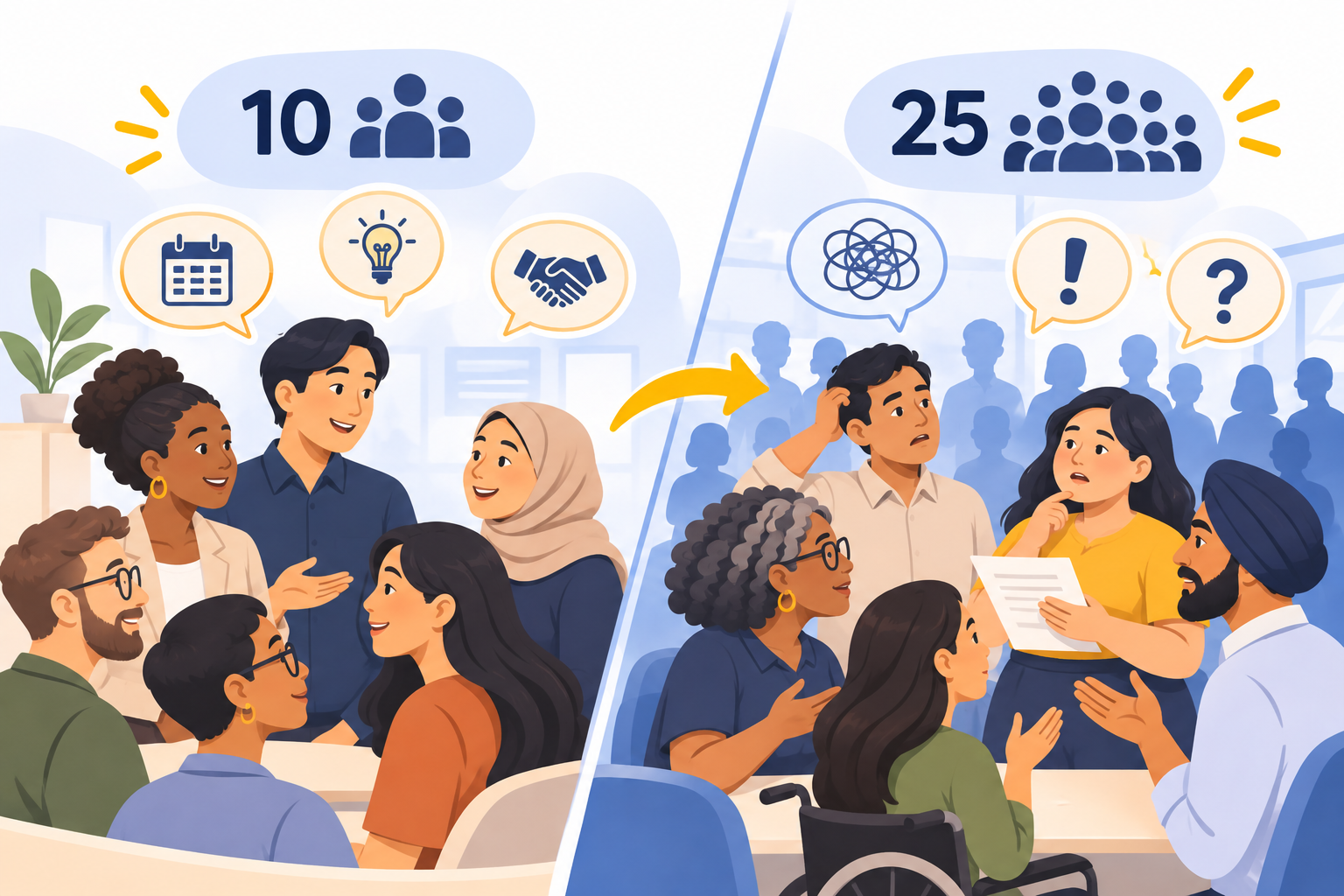
At 10 employees, your organization runs on relationships. Everyone knows everyone. Questions get answered in the hallway. The executive director knows each person's schedule, strengths, and family situation. Policies don't feel necessary because problems get solved through conversation.
At 25 employees, that same approach starts to strain. Not because anyone is doing anything wrong, but because the organization has crossed into a different stage of growth.
The practices that made a small team feel nimble and personal can quietly become sources of confusion, inconsistency, and risk.
What changes between 10 and 25
Growth from 10 to 25 employees changes how an organization works in several ways:
Communication gets harder. Information no longer reaches everyone naturally. People start hearing about decisions secondhand, or not at all.
Layers of supervision appear. The executive director can no longer directly manage everyone, so new supervisors take on people management, often for the first time.
Consistency becomes visible. With more employees, differences in how people are treated, paid, or held accountable are easier to notice and compare.
Specialized roles emerge. Jobs become more defined, and the "everyone does a little of everything" approach starts to fade.
Legal obligations change, too
Headcount affects more than culture. Several federal employment laws apply only once an organization reaches a certain number of employees. Title VII of the Civil Rights Act and the Americans with Disabilities Act generally apply at 15 employees. The Age Discrimination in Employment Act and federal COBRA continuation coverage generally apply at 20.
State laws often apply at lower thresholds, and some apply regardless of size. An organization that grows from 10 to 25 may take on significant new compliance obligations without realizing it.
Systems that start to strain
In organizations moving through this stage, the same practices tend to show signs of wear:
HR lives with the executive director. What was manageable for 10 people becomes a significant drain on leadership time at 25.
Employee records are scattered. Information sits in email threads, spreadsheets, and filing cabinets, with no consistent system.
Policies are mostly verbal. People rely on "how we've always done it," which different supervisors may interpret differently.
Pay is set case by case. Without ranges, every hire and raise becomes a separate negotiation.
Onboarding depends on who's available. New employees have very different experiences depending on timing and their supervisor.
Performance conversations are informal. Feedback happens when there's a problem, not as part of a regular rhythm.
None of these practices was wrong for a small team. They simply weren't built to scale.
What growth-stage infrastructure includes
The goal isn't to turn a close-knit organization into a bureaucracy. It's to put enough structure in place that people are treated consistently, leaders have time to lead, and the organization meets its obligations. For most organizations at this stage, that means:
An up-to-date employee handbook that reflects current law, your location, and how you actually operate
Accurate job descriptions and a clear organizational structure
Pay ranges that guide hiring and raises
A consistent hiring and onboarding process
A simple performance management rhythm with regular check-ins
Organized, secure employee records
Supervisor support for new managers taking on people responsibilities
A compliance review to confirm you're meeting the obligations that come with your current size
Grow into it on purpose
The best time to build growth-stage infrastructure is before you need it. If your organization is approaching 15 or 20 employees, or expects to add staff through new funding, that's the moment to assess where you stand.
Start by reviewing your current practices against your size and plans. Identify the gaps that carry the most risk, then the ones creating the most daily friction. Address those first, and build the rest in stages. Putting systems in place ahead of your next round of hiring means new employees join an organization that's ready for them.
Keep in mind that infrastructure can protect your culture rather than erode it. Clear, consistent practices are often what allow a growing organization to stay fair, transparent, and connected as it gets bigger.
Build systems for the organization you're becoming
Growth is a sign of success. Your HR systems should support it, not hold it back.
E/E Business & Finance Solutions helps growing nonprofits assess their current HR practices and build the infrastructure their next stage requires, from handbooks and pay ranges to onboarding, performance systems, and compliance reviews.
If your organization has grown past the point where informal systems still hold up, let's talk about what your next stage needs. Schedule a growth-stage HR conversation with E/E.
