
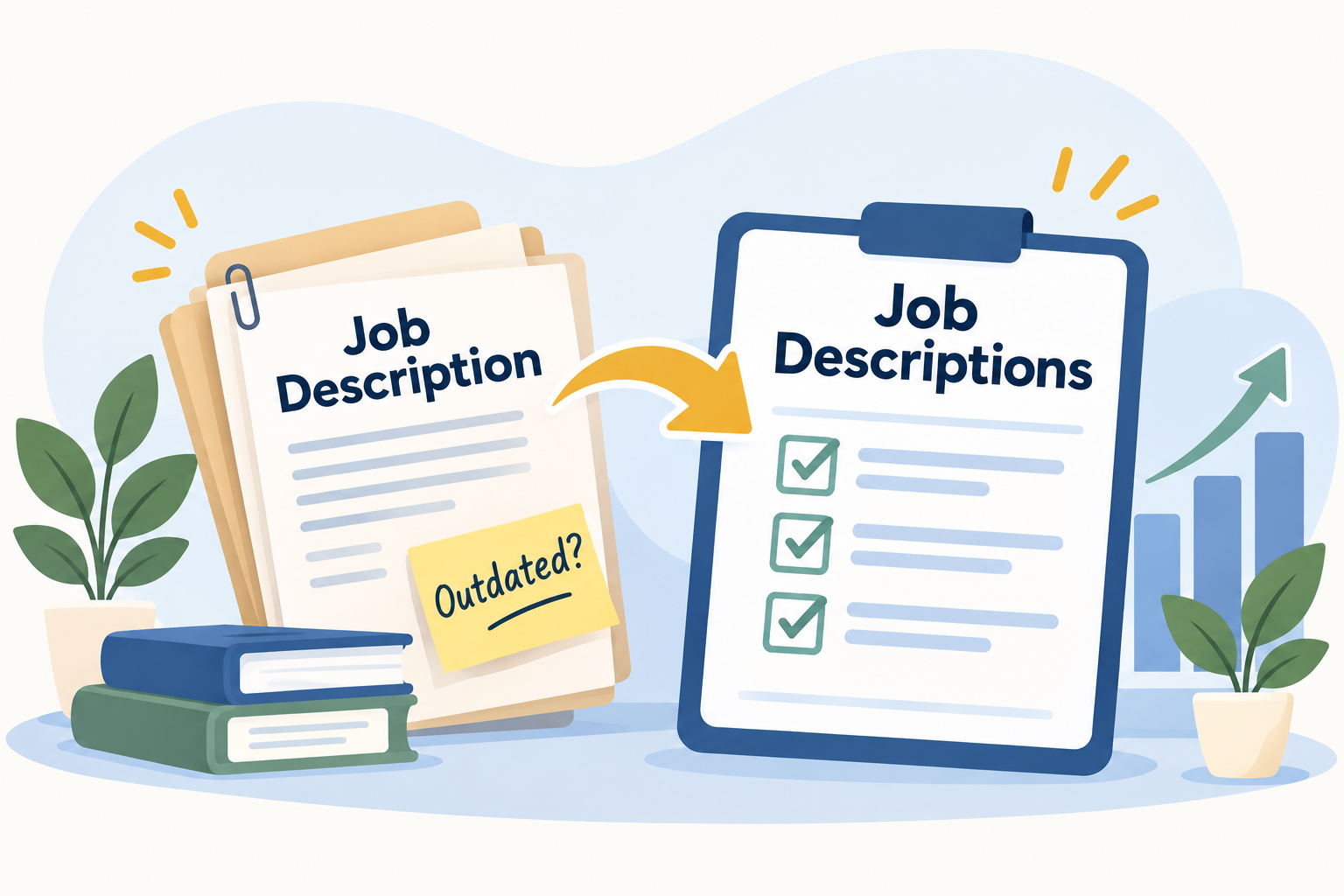
Outdated job descriptions can undermine hiring, compensation, performance management, and accountability. Learn how to align employee responsibilities with your organization's current needs.
Pull up the job description for one of your longest-serving employees. There's a good chance it was written when your organization had a third of the staff it has now, a fraction of the budget, and a very different set of programs.
The person in that role has grown with the organization. They've picked up new responsibilities, trained new staff, and stepped into gaps no one planned for. The document describing their job hasn't changed at all.
This is one of the most common patterns in growing nonprofits, and one of the easiest to overlook. Job descriptions feel like paperwork. In practice, they sit underneath almost every people decision you make.
Signs your job descriptions are out of date
Employees describe their jobs very differently than the written description does
"Other duties as assigned" is carrying a large share of the actual work
Two people believe they're responsible for the same thing, or no one believes they are
Some roles have no written description at all
You reuse an old description every time you post a position, with minor edits
Titles no longer reflect the level or scope of the work
If more than one of these sounds familiar, your organization has outgrown its role definitions.
Why it matters more than it seems
Outdated job descriptions affect far more than a file in a drawer:
Hiring. Postings built on old descriptions attract candidates for the job as it used to be.
Performance. It's hard to evaluate someone fairly against responsibilities that no longer match their work.
Pay and classification. A role's duties drive its pay level and whether it's exempt or non-exempt under wage and hour law. When duties change, classification may need to change too.
Accommodation. Clearly defined essential functions matter when an employee requests an accommodation.
Grant budgets. Funders may expect staff time to align with defined roles and effort reporting.
Continuity. When someone leaves, an accurate description is often the only record of everything they handled.
The gap between the description and the job
In small organizations, roles grow around people. A capable program coordinator starts handling volunteer scheduling, then grant reports, then onboarding new staff. None of it was planned. It happened because the work needed doing and they were good at it.
That flexibility helps early on. Over time, though, it creates roles that depend on the individual rather than the position. When that person leaves, no one is quite sure what they did, and the replacement is hired into a job that doesn't match the description they applied for.
Updating job descriptions isn't about limiting that flexibility. It's about recognizing the work that's actually happening and deciding, on purpose, where it belongs.
How to update them
A practical approach:
Talk with the employee and their supervisor. Ask what the role really involves, how time is spent, and what has been added or dropped.
Define the role's purpose. In one or two sentences, explain why the position exists and how it supports the mission.
List key responsibilities. Focus on the five to eight areas that make up most of the work, not every task.
Clarify decision-making and reporting. Note who the role reports to, who reports to it, and what decisions it owns.
Set qualifications and essential functions. Separate what's required from what's preferred, and include physical or scheduling requirements where relevant.
Look across roles, not just within them. Check for overlaps and gaps between positions before finalizing anything.
Review classification and pay level. Confirm the updated duties still fit the role's current classification and pay range.
Keep them current
A job description is only useful if it stays accurate. Build a few natural review points into your calendar:
Once a year, alongside performance conversations
Whenever a position is about to be posted
When responsibilities shift because of a new program, grant, or reorganization
When someone takes on significant new duties or leaves the organization
These reviews take far less effort than a full rewrite years from now, and they keep your roles aligned with the organization you've become.
Define the roles your organization needs now
Growth is a sign that your work is succeeding. Your job descriptions should reflect that growth, not the organization you were years ago.
E/E Business & Finance Solutions helps nonprofits bring role clarity to growing teams, from documenting how positions actually work to rewriting job descriptions, reviewing classification, and aligning roles across the organization.
If your job descriptions no longer match the work your staff is doing, let's talk about bringing them up to date. Schedule a role clarity conversation with E/E.
