
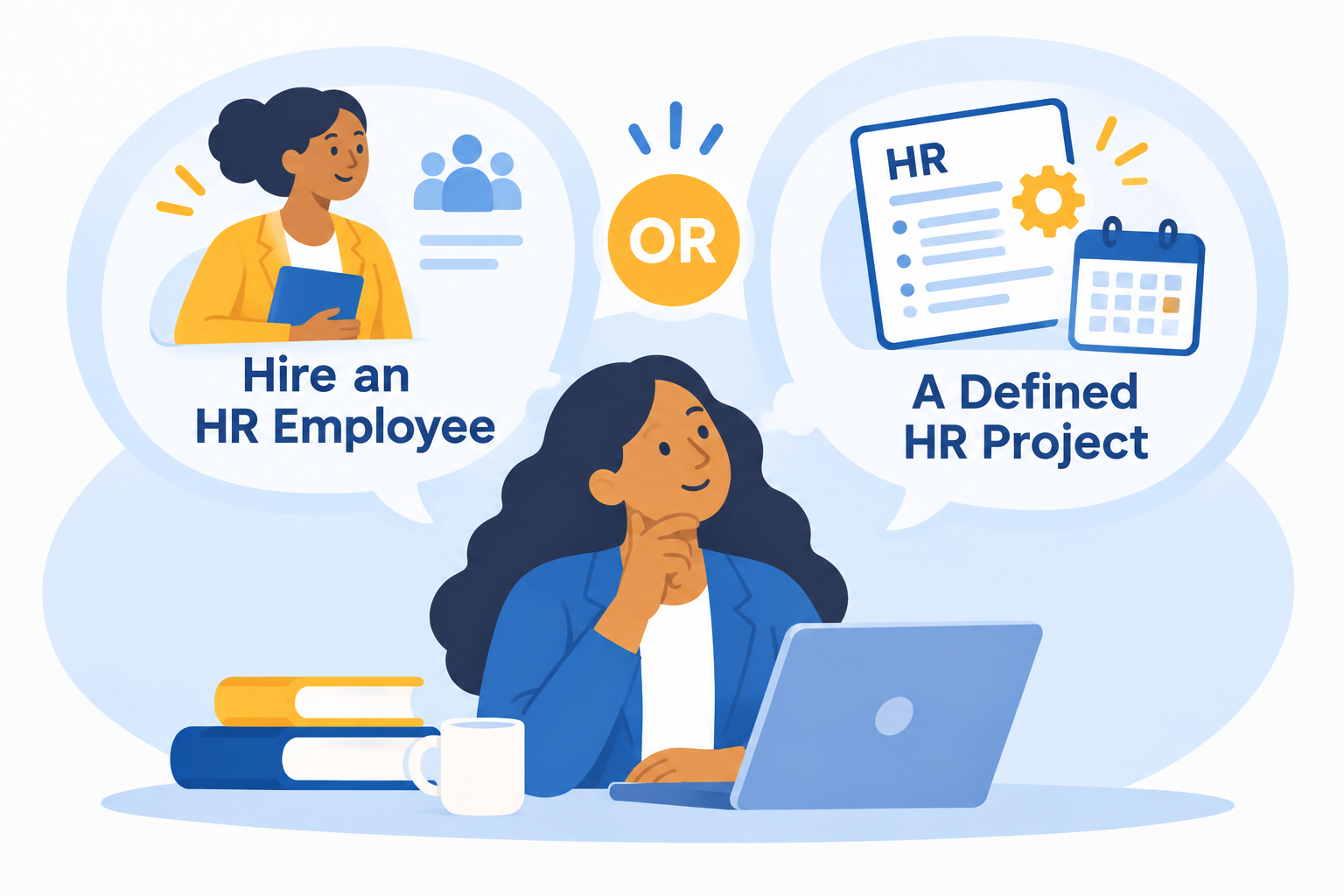
Not every HR challenge requires a permanent employee. Discover when a focused, project-based engagement may be a more practical and cost-effective solution.
At some point, nearly every growing nonprofit hears the same suggestion from a board member, a funder, or an exhausted executive director: "We need to hire an HR person."
Sometimes that's exactly right. But often, what the organization actually needs isn't another permanent position. It's a specific body of work that has to get done well, once, and then maintained.
Telling the difference can save your organization significant money and lead to better results.
Two very different kinds of HR need
HR work generally falls into two categories.
Ongoing operational work happens every week and never ends: processing payroll changes, managing benefits enrollment, answering employee questions, handling leave requests, and supporting day-to-day employee relations.
Building and fixing work has a beginning and an end: writing or updating an employee handbook, creating a compensation structure, rewriting job descriptions, redesigning the organizational structure, setting up a performance management system, or preparing for a major transition.
Many organizations that believe they need an HR employee are really feeling the weight of the second category. The foundations are missing or outdated, and that gap is creating the daily friction everyone notices.
When a hire makes sense
A permanent HR position is often the right choice when:
The volume of ongoing HR administration consistently exceeds what existing staff can absorb
Your headcount has reached a point where employee relations needs regular, dedicated attention
You have multiple locations, complex benefits, or frequent hiring
Your foundational policies and systems are already in place and mainly need to be run and maintained
In those situations, a dedicated HR professional adds lasting value every day.
When a defined project makes more sense
A project-based approach is often the better fit when:
The main problem is missing or outdated foundations, not ongoing volume
You need specialized expertise, such as compensation design or organizational restructuring, that a generalist hire may not bring
The work has a clear finish line
Your budget can't support a full salary and benefits package year after year
You're facing a time-sensitive event, like new funding, rapid growth, or a transition out of fiscal sponsorship
Hiring a permanent employee to build foundations can also create an awkward mismatch. Once the building is done, the role may not have enough ongoing work to justify itself, or it may require a different skill set than the one you hired for.
What a project-based engagement looks like
A well-run HR project is defined before it begins. It typically includes:
A clear scope that spells out what will and won't be covered
Specific deliverables, such as a completed handbook, a set of job descriptions, or a pay structure
A defined timeline with milestones your team can plan around
Collaboration with leadership and staff so the results fit how your organization actually works
A handoff plan so your team knows how to use and maintain what was built
At E/E, this is how we structure our work. The Nonprofit HR Foundation Package, for example, puts essential HR foundations in place over a 60-day timeline. You get the expertise you need for the work in front of you without adding a permanent position you may not yet need.
Questions to help you decide
Before posting an HR position, work through these questions with your leadership team or board:
What specific problems are we trying to solve?
Are those problems caused by too much ongoing work, or by missing systems and policies?
Will this work still exist at the same level in 12 to 18 months?
Does the work require specialized expertise we can't reasonably expect from one hire?
What can our budget sustain over several years, not just this year?
If your answers point mostly toward building and fixing, a defined project is likely the smarter first step. Many organizations find that once their foundations are in place, they can manage day-to-day HR with existing staff for longer than they expected. And when the time does come to hire, that person walks into a structure they can run, rather than one they have to build from scratch.
Start with the project your organization needs
The goal isn't to avoid hiring. It's to make sure every HR investment matches the actual need.
E/E Business & Finance Solutions works with nonprofits through defined, project-based engagements, with clear scopes, deliverables, and timelines, so you get the foundations you need without committing to a permanent position before you're ready.
If you're weighing whether to hire or to build, let's talk through what your organization needs right now. Schedule a project scoping conversation with E/E.
