
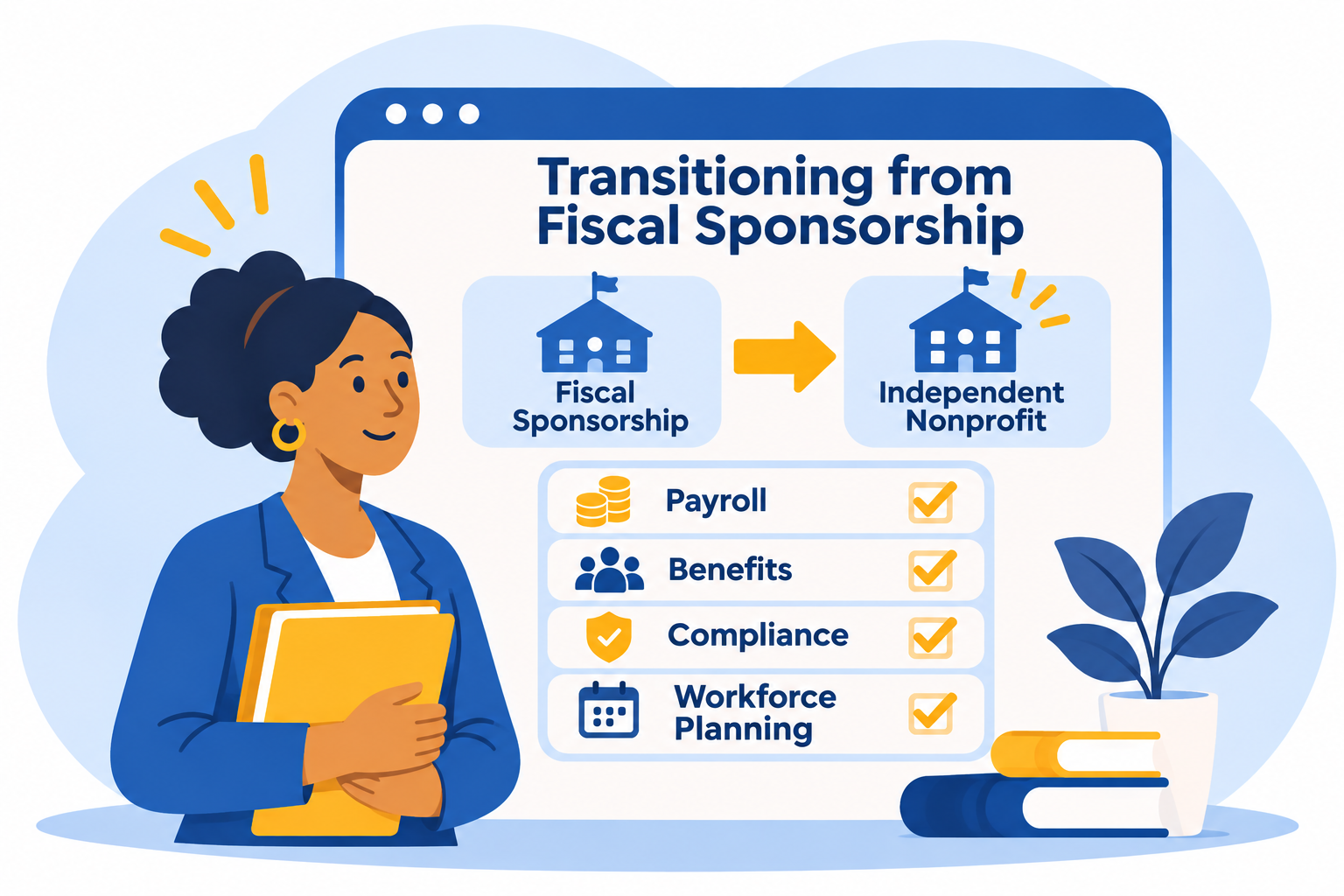
Transitioning from fiscal sponsorship means taking on new employer responsibilities. Understand the payroll, benefits, compliance, and workforce planning decisions that must be addressed before independence.
Leaving a fiscal sponsor is a milestone. It means your project has proven itself, built a funding base, and earned the chance to stand on its own.
Most of the planning conversations focus on the visible pieces: securing tax-exempt status, forming a board, opening bank accounts, and transferring grants. HR often comes up last, sometimes just weeks before the transition date.
That's a risk. If your sponsor has been the employer of record for your staff, independence doesn't just change your legal structure. It changes who employs every person on your team.
What your sponsor was quietly handling
Under many fiscal sponsorship arrangements, especially comprehensive models where staff are employees of the sponsor, the sponsor carries a long list of employer responsibilities:
Running payroll and withholding and filing employment taxes
Providing health insurance, retirement plans, and other benefits
Carrying workers' compensation and unemployment insurance
Maintaining personnel files and employment records
Supplying the employee handbook and workplace policies
Managing compliance with wage, hour, leave, and anti-discrimination laws
Handling employee relations issues when they come up
Because this work happens in the background, project leaders often don't realize how much of it there is until they have to replace it. The details vary by sponsorship agreement, so start by reviewing exactly what yours covers.
Your staff are about to change employers
For your employees, independence means leaving one employer and joining a new one, even if their desk, duties, and supervisor stay exactly the same. That raises practical questions they'll want answered:
Will there be a gap in health coverage?
What happens to accrued vacation or paid time off?
Will retirement contributions continue, and how?
Does their length of service carry over for benefits eligibility?
Will their pay, title, or schedule change?
Each of these needs a decision, and some, like benefits continuity and PTO, may require coordination with your sponsor well before the transition date.
Build the employer infrastructure first
Before your first independent payroll, your new organization needs the basic foundation of an employer in place:
Federal and state employer registrations, including your EIN, state withholding, and unemployment insurance accounts
A payroll system or provider set up and tested before the first pay date
Workers' compensation coverage effective on day one
Benefits plans selected and ready, timed to avoid gaps in coverage
New hire paperwork for every employee, since each person is starting with a new employer
Personnel files and recordkeeping systems for employment records
Required workplace postings and notices
An employee handbook and core policies that belong to your organization
Some of these items take weeks to finalize. Benefits in particular often depend on carrier timelines and enrollment windows you don't control.
Decide what carries over and what changes
Independence is a natural moment to look at how your HR practices work, not just to copy them.
Your sponsor's policies were written for the sponsor's organization. Some may fit you well. Others may not reflect your size, culture, location, or programs. Rather than adopting them wholesale, decide which policies you need, what each should say, and where your organization wants to do things differently.
The same goes for your staff structure. Review job descriptions, titles, pay levels, and exempt or non-exempt classifications now. It's much easier to set things up correctly at the start than to correct them after the transition.
Talk with your staff early
Uncertainty about employment travels fast. Even loyal, mission-driven employees will worry about their paychecks and health coverage if they hear about the transition secondhand or too late.
Share the timeline as soon as it's firm. Explain what will change, what will stay the same, and what's still being decided. Give people a clear way to ask questions, and follow up in writing so they have something to refer back to. A well-handled transition can actually strengthen trust in leadership.
Time the transition carefully
Your independence date affects more than your legal status. When choosing it, consider:
Payroll periods, so employees aren't caught between two pay schedules
Benefits plan years and enrollment timing, to avoid gaps or duplicate costs
Grant transfers and reporting periods, so personnel costs land in the right place
Year-end tax reporting, since a mid-year change means employees receive tax forms from both employers
Working backward from the date gives you a realistic plan for when each HR piece needs to be in place.
Plan your HR transition before your independence date
The shift from sponsored project to independent organization is a chance to build HR infrastructure that fits who you are, rather than inheriting it by default.
E/E Business & Finance Solutions helps fiscally sponsored projects plan and carry out the HR side of independence, from mapping what your sponsor handles today to building policies, setting up employee transitions, and creating a timeline that keeps your team supported throughout.
If your project is preparing to leave its fiscal sponsor, let's make sure your people are part of the plan from the beginning. Schedule a transition planning conversation with E/E.
